
Producers and lawmakers alike have been sounding the alarm for months: the farm economy is in a dire state. Our latest article detailed the harsh reality on the ground. High input costs, low commodity prices, and multiple years of downturn have farmers staring down a sea of red ink.
This reality felt across the countryside was further illustrated in the release of USDA’s 2026 Farm Sector Income Forecast. Farm sector income is set to decline further in 2026, even after farm program payments and emergency assistance.
In covering the report, Dr. Faith Parum and Mr. Daniel Munch, American Farm Bureau Federation economists wrote, “USDA projects net farm income will slip lower in 2026 and remain roughly $48 billion (24%) below the record highs reached in 2022, underscoring a generational downturn in the farm economy.”
The data is staggering.
Estimated losses per acre for several major row crops in the current marketing year alone are in the hundreds of dollars – and this is a continuation of a troubling trend over the past several years.
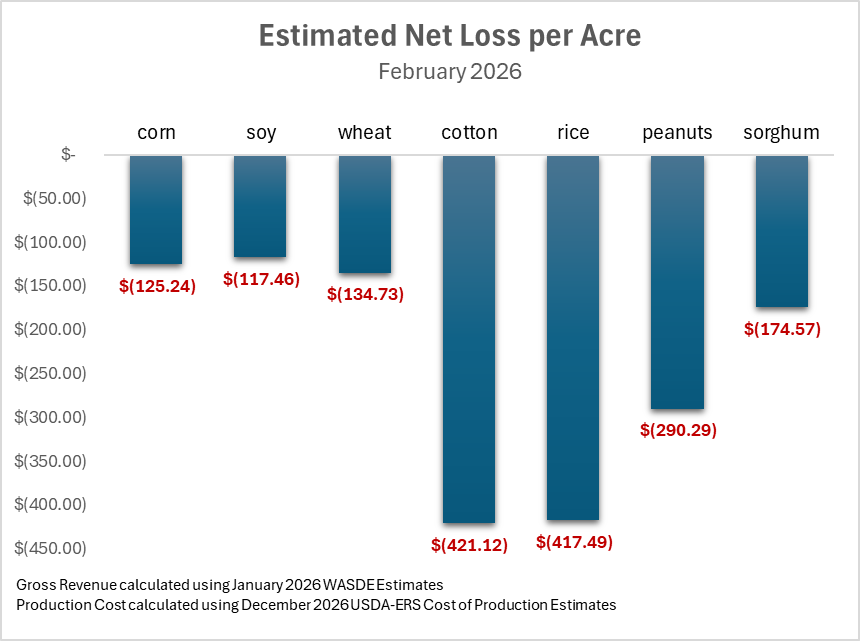 Drs. Joe Outlaw and Bart Fischer with Texas A&M University’s Agricultural and Food Policy Center summed up the magnitude of losses well in their recent Southern Agriculture Today article:
“Over the last 3 years—from 2023 to 2025—the losses have been piling up. [The] average corn, soybean, and wheat producer has accumulated roughly $300 per acre in total losses over the last 3 years. For cotton producers, that estimate is roughly $1,000 per acre. After all their crops have been sold and all their bills have been paid, that’s how far in the hole they remain.”
What does a “loss” mean in this context, and why does it matter?
You may have heard the saying, “farmers are price takers, not price makers.”
This means that unlike most business owners, farmers can’t adjust the price for their goods to try to protect their margins when input costs go up. Rather, the market dictates what price producers will receive.
Consider it this way:
Imagine, for a moment, if doing your job cost more than you earned, and you were expected to find a way to cover the spread and continue on. This is the current reality for farmers. On average over the past 5 years, farmers’ expenses have been 111% of their paychecks, and expenses have gone up by roughly 33%.
Many farmers borrow more each year to run their operations than the average American will in a lifetime, because they must incur business expenses upfront, such as purchasing seeds, fertilizer, and other inputs, in order to plant a crop. In this context, the stakes couldn’t be higher.
Senate Agriculture Committee Chairman John Boozman (R-AR) put it this way: “America’s farmers are resilient… [but] resilience and hard work are not enough to withstand the significant challenges that have been mounting for several years.”
The bottom line? This isn’t sustainable.
So what now?
Lawmakers are publicly weighing the path forward on both another emergency assistance package, and a “Farm Bill 2.0” to address certain provisions that weren’t included in last year’s reconciliation package.
Check out what the top leaders on the House and Senate Agriculture Committees are saying:
- “We’re in a really serious problem right now. If you’re planting something, you’re probably losing money...” – Senate Agriculture Committee Chairman John Boozman (R-AR)
- “Margins are tightening due to low prices, high input costs, and it’s more important than ever to give our farmers a certainty of a Farm Bill reauthorization, even if it’s what we call a skinny Farm Bill...” – Senate Agriculture Committee Ranking Member Amy Klobuchar (D-MN)
- “If you farm and ranch in 2026, things are different than what they were in 2018…The fact is that new challenges require new policy.” House Agriculture Committee Chairman, Congressman GT Thompson (R-PA)
- “My grandfather lost his job in the 1980s farm crisis when the farmer lost his farm, and I have never forgotten that in my work on the Ag Committee. That’s what we have as a responsibility to figure out.” – House Agriculture Committee Ranking Member Angie Craig (D-MN)
USDA’s latest Farm Sector Income Forecast makes it clear: absent timely, targeted support, creative solutions to enhance demand and open new markets, and a long-term Farm Bill that reflects today’s challenges, the risk of collapse in the farm economy will continue to grow.
The data backs up what farm country has been saying: The farm economy is in crisis, and Congress must act.
Need a Farm Bill refresher? Find a high-level, title-by-title history and overview of this crucial piece of legislation that impacts every American, from the field to the dinner plate, here. Plus, learn about agricultural policy straight from America’s heartland on the Groundwork podcast.